Showing posts with label Congressman Jeff Flake. Show all posts

Wednesday, November 3, 2010

AZ-06 Green Party House Candidate Richard Grayson Concedes: "The People Won't Have Dick Grayson to Kick Around Anymore. Don't Cry for Me, Arizona."


The people have spoken, the subhuman douchebags.

According to the latest election returns, I received more votes than I would have expected in Arizona's Sixth Congressional District: 2,461, or 1.3%. I got more votes than any other Green Party candidate for the U.S. House of Representatives even though the Green Party bosses refused to endorse me and tried to kick me off the ballot by suing me in federal court. (Obviously they lost, but they were losers long before that.)

Congratulations to Jeff Flake on winning his umpteenth term in Congress and to Rebecca Schneider for running such a valiant race on the Democratic ticket and to Libertarian candidate Darrell Tapp on his stylish hat.

Don't cry for me, Arizona. You won't have Dick Grayson to kick around anymore. I am re-registering as a voter in Brooklyn, New York although I will continue to spend winters in the boondocks of Apache Junction.

Thanks again to my voters.

Monday, November 1, 2010

Why the Moronic Moralists Will Win This Election, Why They'll Make the Economy Worse, and Why This Candidate Doesn't Care If You Vote for Him or Not


If you've already voted for me or will vote for me tomorrow, thank you. I appreciate it very much although certainly there's no way that career politician Jeff Flake can lose his seat in Congress. A vote for me -- or for the fine Democratic candidate, Rebecca Schneider -- is basically a protest vote by someone who's actually living in the real world.

However, most of you who live in Arizona's Sixth Congressional District -- the East Valley cities of Mesa, Chandler, Gilbert, Apache Junction and Queen Creek -- are ignorant morons. That's why I don't give a fuck if anyone votes for me or not.

That gives me the freedom politician candidates don't have. I can say what I feel and do what I think is right without having to care about whether the unwashed masses agree. Maybe I'll get 100 votes or so, votes for which I'm grateful, but in the end, it doesn't matter.

The overriding issue in this election is the terrible economy.
Unfortunately, morons like most Sixth Congressional District voters will just make things worse. In his New York Times column today, the Nobel-winning economist Paul Krugman explains why. It's essentially Macroeconomics 101 for Dummies, and so most East Valley residents can use it:
“How many of you people want to pay for your neighbor’s mortgage that has an extra bathroom and can’t pay their bills?” That’s the question CNBC’s Rick Santelli famously asked in 2009, in a rant widely credited with giving birth to the Tea Party movement.

It’s a sentiment that resonates not just in America but in much of the world. The tone differs from place to place — listening to a German official denounce deficits, my wife whispered, “We’ll all be handed whips as we leave, so we can flagellate ourselves.” But the message is the same: debt is evil, debtors must pay for their sins, and from now on we all must live within our means.

And that kind of moralizing is the reason we’re mired in a seemingly endless slump.

The years leading up to the 2008 crisis were indeed marked by unsustainable borrowing, going far beyond the subprime loans many people still believe, wrongly, were at the heart of the problem. Real estate speculation ran wild in Florida and Nevada, but also in Spain, Ireland and Latvia. And all of it was paid for with borrowed money.

This borrowing made the world as a whole neither richer nor poorer: one person’s debt is another person’s asset. But it made the world vulnerable. When lenders suddenly decided that they had lent too much, that debt levels were excessive, debtors were forced to slash spending. This pushed the world into the deepest recession since the 1930s. And recovery, such as it is, has been weak and uncertain — which is exactly what we should have expected, given the overhang of debt.

The key thing to bear in mind is that for the world as a whole, spending equals income. If one group of people — those with excessive debts — is forced to cut spending to pay down its debts, one of two things must happen: either someone else must spend more, or world income will fall.

Yet those parts of the private sector not burdened by high levels of debt see little reason to increase spending. Corporations are flush with cash — but why expand when so much of the capacity they already have is sitting idle? Consumers who didn’t overborrow can get loans at low rates — but that incentive to spend is more than outweighed by worries about a weak job market. Nobody in the private sector is willing to fill the hole created by the debt overhang.

So what should we be doing? First, governments should be spending while the private sector won’t, so that debtors can pay down their debts without perpetuating a global slump. Second, governments should be promoting widespread debt relief: reducing obligations to levels the debtors can handle is the fastest way to eliminate that debt overhang.

But the moralizers will have none of it. They denounce deficit spending, declaring that you can’t solve debt problems with more debt. They denounce debt relief, calling it a reward for the undeserving.

And if you point out that their arguments don’t add up, they fly into a rage. Try to explain that when debtors spend less, the economy will be depressed unless somebody else spends more, and they call you a socialist. Try to explain why mortgage relief is better for America than foreclosing on homes that must be sold at a huge loss, and they start ranting like Mr. Santelli. No question about it: the moralizers are filled with a passionate intensity.

And those who should know better lack all conviction.

John Boehner, the House minority leader, was widely mocked last year when he declared that “It’s time for government to tighten their belts” — in the face of depressed private spending, the government should spend more, not less. But since then President Obama has repeatedly used the same metaphor, promising to match private belt-tightening with public belt-tightening. Does he lack the courage to challenge popular misconceptions, or is this just intellectual laziness? Either way, if the president won’t defend the logic of his own policies, who will?

Meanwhile, the administration’s mortgage modification program — the program that inspired the Santelli rant — has, in the end, accomplished almost nothing. At least part of the reason is that officials were so worried that they might be accused of helping the undeserving that they ended up helping almost nobody.

So the moralizers are winning. More and more voters, both here and in Europe, are convinced that what we need is not more stimulus but more punishment. Governments must tighten their belts; debtors must pay what they owe.

The irony is that in their determination to punish the undeserving, voters are punishing themselves: by rejecting fiscal stimulus and debt relief, they’re perpetuating high unemployment. They are, in effect, cutting off their own jobs to spite their neighbors.

But they don’t know that. And because they don’t, the slump will go on.

¿Comprende?

Sunday, October 24, 2010

Rep. Jeff Flake Calls for Post-Election Return of U.S. to Robbery by Corporate Insiders Who Destroyed Their Own Companies and Caused Worldwide Crisis


Speaking on Fox News Sunday, Arizona Rep. Jeff Flake said he looked forward to re-election to the House of Representatives, where he expects his fellow Republicans will win at least a 7,000-seat majority. He called for a return to letting corporate insiders rob America blind while bankrupting their own companies and plunging the world economy into an even more effective Great Depression-like crisis. Flake suggested that after the election, President Obama should resign immediately and that the late Austrian economist Fredrich Hayek be sworn in to replace him as the new U.S. President.

The Arizona Republican said he was delighted with the prospect of "limited government run by people of limited intelligence" like himself and vowed that in the next Congress he would "work very hard to further concentrate wealth in this country among the few billionaires with the prescience to provide me with campaign contributions."

Wednesday, October 13, 2010

Jeff Flake, Arizona Is in an Economic Depression and You Do Nothing But Extol Free Markets and Ask for Tax Cuts for Millionaires


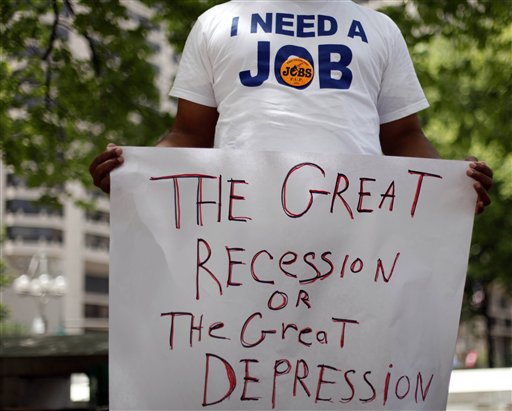
Tomorrow's New York Times features a very long front-page story by our friends Michael Powell and Motoko Rich, "Across the U.S., Long Recovery Looks Like Recession." For those of us in the East Valley and in Pinal County, where our house is, the Great Recession's sputtering recovery seems more like the Great Depression:

Florence, Ariz.

In 2005, Arizona ranked, as usual, second nationally in job growth behind Nevada, its economy predicated on growth. The snowbirds came and construction boomed and land stretched endless and cheap. Then it stopped.

This year, Arizona ranks 42nd in job growth. It has lost 287,000 jobs since the recession began, and the fall has been calamitous.

Renee Wheaton, 38, sits in an old golf cart on the corner of Tangerine and Barley Roads in her subdivision in the desert, an hour south of Phoenix. Her next-door neighbor, an engineer, just lost his job. The man across the street is unemployed.

Her family is not doing so well either. Her husband’s hours have been cut by 15 percent, leaving her family of five behind on water and credit card bills — more or less on everything except the house and car payment. She teaches art, but that’s not much in demand.

“I say to myself ‘This can’t be happening to us: We saved, we worked hard and we’re under tremendous stress,’ ” Ms. Wheaton says. “My husband is a very hard-working man but for the first time, he’s having real trouble.”

Arizona’s poverty rate has jumped to 19.6 percent, the second-highest in the nation after Mississippi. The Association of Arizona Food Banks says demand has nearly doubled in the last 18 months.

Elliott D. Pollack, one of Arizona’s foremost economic forecasters, said: “You had an implosion of every sector needed to survive. That’s not going to get better fast.”

To wander exurban Pinal County, which is where Florence is located, is to find that the unemployment rate tells just half the story. Everywhere, subdivisions sit in the desert, some half-built and some dreamy wisps, like the emerald green putting green sitting amid acres of scrub and cacti. Signs offer discounts, distress sales and rent with the first and second month free.

Discounts do not help if your income is cut in half. Construction workers speak of stringing together 20-hour weeks with odd jobs, and a 45-year-old woman who was a real estate agent talks of her job making minimum wage bathing elderly patients. Many live close to the poverty line, without the conveniences they once took for granted. Pinal’s unemployment rate, like that of Arizona, stands at 9.7 percent, but state officials say that the real rate rises closer to 20 percent when part-timers and those who have stopped looking for work are added in.

At an elementary school near Ms. Wheaton’s home, an expansion of the school’s water supply was under way until thieves sneaked in at night and tore the copper pipes out of the ground to sell for scrap.

Five miles southwest, in Coolidge, a desert town within view of the distant Superstition Mountains, demand has tripled at Tom Hunt’s food pantry. Some days he runs out.

Henry Alejandrez, 60, is a roofer who migrated from Texas looking for work. “It’s gotten real bad,” he says. “I’m a citizen, and you’re lucky if you get minimum wage.”

Mary Sepeda, his sister, nods. She used to drive two hours to clean newly constructed homes before they were sold. That job evaporated with the housing market. (Arizona issued 62,500 housing permits several years ago; it gave out 8,400 last year.)

“It’s getting crazy,” she says, holding up a white plastic bag of pantry food. “How does this end?”

You put that question to Mr. Pollack, the forecaster. “We won’t recover until we absorb 80,000 empty houses and office buildings and people can borrow again,” he says.

When will that be?

“I’m forecasting recovery by 2013 to 2015,” he says.

Hmm, Jeff Flake will be his seventh or eighth term in Congress by then. Till that time, he'll continue his crusade against any government spending to stimulate the economy, he'll continue voting against unemployment insurance and any "safety net" for the middle class-turned-poor, and he'll continue his fight to make sure that comfortable millionaires and billionaires pay no taxes.

And of course he'll take credit for the eventual economic recovery although he did everything he could -- deregulate and let the money men run wild on Wall Street -- to create the Great Recession.

And of course you, the asshole voters of the Sixth Congressional District, will just keep voting for him and the other right-wing Republicans.

Monday, October 11, 2010

Democrat Rebecca Schneider's October Suprise


We're running a totally untraditional and unconventional campaign here at Richard Grayson Green Party AZ-06 HQ, so we're turning this post over to our fellow opponent of Jeff Flake, the Democratic candidate in Arizona's Sixth Congressional District, Rebecca Schneider. Here'a an email we got from her campaign today:

Please join Rebecca at a very important press conference tomorrow at 1pm in front of the State Capitol Building in Phoenix. (1700 W. Washington St. Phoenix, AZ 85007).

It is here that she will be making two very big announcements:

1) If she is elected as your representative in Congress, Rebecca will donate 50% of her net congressional salary to local organizations dedicated to getting the people of this district back to work. She will continue to personally fund these efforts throughout her first year in office.

Many political candidates make promises to improve our economy or "bring jobs to Arizona." Rebecca is willing to go a step further and put her money where her mouth is. She will work to improve our economy. She will bring jobs to the East Valley - and she will put her paycheck on the line to do it.

2) We have a great new series of videos called "Flakeville" that show what our district might be like if Jeff Flake gets another two years in office.


Here's the first episode, "The Lay-off," of Flakeville at Democratic candidate Rebecca Schneider's website,

and you can catch the subsequent nine episodes here.

Sunday, October 3, 2010

Why Third Parties Like the Green Party Are Important and Why Jeff Flake Voters Will All Go Fuck Themselves


As a third-party candidate, I found today's New York Times column, "Third Party Rising," by Thomas L. Friedman relevant (emphasis ours):
A friend in the U.S. military sent me an e-mail last week with a quote from the historian Lewis Mumford’s book, “The Condition of Man,” about the development of civilization. Mumford was describing Rome’s decline: “Everyone aimed at security: no one accepted responsibility. What was plainly lacking, long before the barbarian invasions had done their work, long before economic dislocations became serious, was an inner go. Rome’s life was now an imitation of life: a mere holding on. Security was the watchword — as if life knew any other stability than through constant change, or any form of security except through a constant willingness to take risks.”

It was one of those history passages that echo so loudly in the present that it sends a shiver down my spine — way, way too close for comfort.

I’ve just spent a week in Silicon Valley, talking with technologists from Apple, Twitter, LinkedIn, Intel, Cisco and SRI and can definitively report that this region has not lost its “inner go.” But in talks here and elsewhere I continue to be astounded by the level of disgust with Washington, D.C., and our two-party system — so much so that I am ready to hazard a prediction: Barring a transformation of the Democratic and Republican Parties, there is going to be a serious third party candidate in 2012, with a serious political movement behind him or her — one definitely big enough to impact the election’s outcome.

There is a revolution brewing in the country, and it is not just on the right wing but in the radical center. I know of at least two serious groups, one on the East Coast and one on the West Coast, developing “third parties” to challenge our stagnating two-party duopoly that has been presiding over our nation’s steady incremental decline.
President Obama has not been a do-nothing failure. He has some real accomplishments. He passed a health care expansion, a financial regulation expansion, stabilized the economy, started a national education reform initiative and has conducted a smart and tough war on Al Qaeda.

But there is another angle on the last two years: a president who won a sweeping political mandate, propelled by an energized youth movement and with control of both the House and the Senate — about as much power as any president could ever hope to muster in peacetime — was only able to pass an expansion of health care that is a suboptimal amalgam of tortured compromises that no one is certain will work or that we can afford (and doesn’t deal with the cost or quality problems), a limited stimulus that has not relieved unemployment or fixed our infrastructure, and a financial regulation bill that still needs to be interpreted by regulators because no one could agree on crucial provisions. Plus, Obama had to abandon an energy-climate bill altogether, and if the G.O.P. takes back the House, we may not have an energy bill until 2013.

Obama probably did the best he could do, and that’s the point. The best our current two parties can produce today — in the wake of the worst existential crisis in our economy and environment in a century — is suboptimal, even when one party had a huge majority. Suboptimal is O.K. for ordinary times, but these are not ordinary times. We need to stop waiting for Superman and start building a superconsensus to do the superhard stuff we must do now. Pretty good is not even close to good enough today.

“We basically have two bankrupt parties bankrupting the country,” said the Stanford University political scientist Larry Diamond. Indeed, our two-party system is ossified; it lacks integrity and creativity and any sense of courage or high-aspiration in confronting our problems. We simply will not be able to do the things we need to do as a country to move forward “with all the vested interests that have accrued around these two parties,” added Diamond. “They cannot think about the overall public good and the longer term anymore because both parties are trapped in short-term, zero-sum calculations,” where each one’s gains are seen as the other’s losses.

We have to rip open this two-party duopoly and have it challenged by a serious third party that will talk about education reform, without worrying about offending unions; financial reform, without worrying about losing donations from Wall Street; corporate tax reductions to stimulate jobs, without worrying about offending the far left; energy and climate reform, without worrying about offending the far right and coal-state Democrats; and proper health care reform, without worrying about offending insurers and drug companies.

“If competition is good for our economy,” asks Diamond, “why isn’t it good for our politics?”


We need a third party on the stage of the next presidential debate to look Americans in the eye and say: “These two parties are lying to you. They can’t tell you the truth because they are each trapped in decades of special interests. I am not going to tell you what you want to hear. I am going to tell you what you need to hear if we want to be the world’s leaders, not the new Romans.”

The Arizona Green Party's incompetent and small-minded bosses, of course, have made the party a laughingstock with their poor planning and Keystone Kops strategies, but it's still a valuable vehicle for candidates like myself as a ballot line alternative for progressives dissatisfied with Democrats and Republicans.

As Dan Cantor of the Working Families Party has stated,
Most days of the year, money triumphs over all things in our society. Except on Election Day, when we're all citizens and we get to vote. There are two conceptions wrestling with each other in America right now: The tea party is saying government is a waste, or evil, even. Our view is that government will be as good as we make it, by electing people who stand for a certain set of values we all share about decency and equality and opportunity...

America had the first great middle-class society, and it was made by two things: unions pushing up and high marginal tax rates pushing down, from the fifties through the seventies. That was a great thing, [but] we’ve abandoned that for, "You need rich people to be really happy so they’ll invest and maybe good things will happen!"...There’s been a growth in low-wage jobs and a growth in extremely high-wage stuff. So the middle is being squeezed.

Millionaire free-market fanatic Jeff Flake is contemptuous of or indifferent to the struggles of those in-the-middle struggling working families. He's done nothing for you in eight years and now he wants to eliminate Medicare, Social Security, unemployment benefits, student loans and every other federal program that lends a helping hand not just to the poor but to the middle class.

When you re-elect Jeff Flake, you're cutting your own throats. But since most of you in the East Valley are dumber than posts, you'll do it, won't you? You Jeff Flake voters can all go fuck yourselves, and on Election Day, you will.

Sunday, September 5, 2010

Why the Failed Wars in Iraq and Afghanistan Must Lead to an End to Our State of Permanent War


One of the Ten Key Values of the Green Party is nonviolence, which says in part, "We will work to demilitarize..." In the wake of the failed wars in Iraq and Afghanistan and a state of perpetual war that has lasted my entire lifetime. Last fall I taught a course in Cold War Literature at City College of New York and while our last book was from the 1970s and the Cold War ended in 1989, not much really changed and within two years we were back in a full-scale war in Iraq, the first Gulf War.

I have no illusions that if I make the ballot, I have any chance of being elected to Congress. Even in the most progressive district, no Green Party candidate has ever come close to getting elected (and only one Green has even ever been elected to a state legislature). Indeed, there hasn't been a U.S. House member from a third party since my Fort Lauderdale neighbor and fellow adjunct professor at Nova Southeastern University, Leo Isacson, won a special election in the Bronx in 1948 on the American Labor Party ticket. (Vito Marcantanio also was an ALP congressman earlier from East Harlem.)

In his year in office, Leo Isacson tried to stop the militarization of the United States: he opposed the Marshall Plan and the peacetime draft and was one of three Congressmen to oppose legislation to increase the size of the Air Force. Perhaps he was extreme, but we do need to stop being the giantic fortress America national security state championed by hawks from Curtis LeMay to Dick Cheney.

Writing in his column in the New York Times today, Frank Rich notes, speaking of President Obama's tone-deaf Oval Office speech on Iraq (Freudian slip: I started to type "Vietnam"):
Of all the commentators on the debacle, few speak with more eloquence or credibility than Andrew Bacevich, a professor of history and international relations at Boston University who as a West Point-trained officer served in Vietnam and the first gulf war and whose son, also an Army officer, was killed in Iraq in 2007. Writing in The New Republic after Obama’s speech, he decimated many of the war’s lingering myths, starting with the fallacy, reignited by the hawks taking a preposterous victory lap last week, that “the surge” did anything other than stanch the bleeding from the catastrophic American blundering that preceded it. As Bacevich concluded: “The surge, now remembered as an epic feat of arms, functions chiefly as a smokescreen, obscuring a vast panorama of recklessness, miscalculation and waste that politicians, generals, and sundry warmongers are keen to forget.”

Bacevich also wrote that “common decency demands that we reflect on all that has occurred in bringing us to this moment.” Americans’ common future demands it too. The war’s corrosive effect on the home front is no less egregious than its undermining of our image and national security interests abroad. As the Pentagon rebrands Operation Iraqi Freedom as Operation New Dawn — a “name suggesting a skin cream or dishwashing liquid,” Bacevich aptly writes — the whitewashing of our recent history is well under way. The price will be to keep repeating it.

We can’t afford to forget now that the single biggest legacy of the Iraq war at home was to codify the illusion that Americans can have it all at no cost. We willed ourselves to believe Paul Wolfowitz when he made the absurd prediction that Iraq’s oil wealth would foot America’s post-invasion bills. We were delighted to accept tax cuts, borrow other countries’ money, and run up the federal deficit long after the lure of a self-financing war was unmasked as a hoax. The cultural synergy between the heedless irresponsibility we practiced in Iraq and our economic collapse at home could not be more naked. The housing bubble, inflated by no-money-down mortgage holders on Main Street and high-risk gamblers on Wall Street, was fueled by the same greedy disregard for the laws of fiscal gravity that governed the fight-now-pay-later war.

Our attitude toward the war’s human cost was no less cavalier. We were all too content to let a volunteer army fight our battles out of sight and out of mind, on a fictional pretext yoked to a military strategy premised on a cakewalk. For too long we looked the other way as the coffins arrived in Dover off camera in the shroud of night, as the maimed endured inhumane treatment in military hospitals at home, and as the Iraqi refugees who aided Operation Iraqi Freedom at their own peril were denied the freedom to seek a safe haven in our country.

Both President Obama and Glenn Beck, in his “Restoring Honor” rally in Washington last weekend, were fulsome in their praise of the troops, as well they should have been. But the disconnect between the civilian public, including the war’s die-hard advocates on the right, and those doing the fighting remains as large today as ever. As one Iraq war vet e-mailed to me after hearing Beck’s patriotic sermons: “What does gathering in D.C. do for the troops?” He was appalled at the self-regard of those who thought their jingoistic rally would help returning troops abandoned by the military’s “criminally poor mental health care” or save any soldier who was “two seconds away from getting his leg blown off by an I.E.D.”

The other American casualties of Iraq include the credibility of both political parties, neither of which strenuously questioned the rush to war and both of which are still haunted by that failure, and of the news media, which barely challenged the White House’s propaganda about Saddam’s imminent mushroom clouds. Many pundits, quite a few of them liberals, stoked the war fever as well.

It's important to reiterate that both Democrats and Republicans were wrong about the war. The Green Party was not.

The same theme of two-party delusion is discussed in a review of Bacevich's book Washington Rules: America’s Path to Permanent War in today's New York Times Book Review. An excerpt from the review by Gary J. Bass:

From Harry S. Truman’s presidency to today, Bacevich argues, Americans have trumpeted the credo that they alone must “lead, save, liberate and ultimately transform the world.” That crusading mission is implemented by what Bacevich caustically calls “the sacred trinity”: “U.S. military power, the Pentagon’s global footprint and an American penchant for intervention.” This threatening posture might have made some sense in 1945, he says, but it is catastrophic today. It relegates America to “a condition of permanent national security crisis.”

Bacevich has two main targets in his sights. The first are the commissars of the national security establishment, who perpetuate these “Washington rules” of global dominance. By Washington, he means not just the federal government, but also a host of satraps who gain power, cash or prestige from this perpetual state of emergency: defense contractors, corporations, big banks, interest groups, think tanks, universities, television networks and The New York Times. He complains that an unthinking Washington consensus on global belligerence is just as strong among mainstream Democrats as among mainstream Republicans. Those who step outside this monolithic view, like Dennis Kucinich or Ron Paul, are quickly dismissed as crackpots, Bacevich says. This leaves no serious checks or balances against the overweening national security state. [emphasis ours]

Bacevich’s second target is the sleepwalking American public. He says that they notice foreign policy only in the depths of a disaster that, like Vietnam or Iraq, is too colossal to ignore. As he puts it, “The citizens of the United States have essentially forfeited any capacity to ask first-order questions about the fundamentals of national security policy.”

Bacevich is singularly withering on American public willingness to ignore those who do their fighting for them. He warns of “the evisceration of civic culture that results when a small praetorian guard shoulders the burden of waging perpetual war, while the great majority of citizens purport to revere its members, even as they ignore or profit from their service.” Here he has a particular right to be heard: on May 13, 2007, his son Andrew J. Bacevich Jr., an Army first lieutenant, was killed on combat patrol in Iraq. Bacevich does not discuss his tragic loss here, but wrote devastatingly about it at the time in The Washington Post: “Memorial Day orators will say that a G.I.’s life is priceless. Don’t believe it. I know what value the U.S. government assigns to a soldier’s life: I’ve been handed the check.”

Bacevich is less interested in foreign policy here (he offers only cursory remarks about the objectives and capabilities of countries like China, Russia, North Korea and Iran) than in the way he thinks militarism has corrupted America. In his acid account of the inexorable growth of the national security state, he emphasizes not presidents, who come and go, but the architects of the system that envelops them: Allen W. Dulles, who built up the C.I.A., and Curtis E. LeMay, who did the same for the Strategic Air Command. Both of them, Bacevich says, would get memorials on the Mall in Washington if we were honest about how the capital really works.

The mandarins thrived under John F. Kennedy, whose administration “was fixating on Fidel Castro with the same feverish intensity as the Bush administration exactly 40 years later was to fixate on Saddam Hussein — and with as little strategic logic.” The Washington consensualists were thrown badly off balance by defeat in Vietnam but, Bacevich says, soon regained their stride under Ronald Reagan and Bill Clinton — setting the stage for George W. Bush. Barack Obama campaigned on change and getting out of Iraq, but when it comes to the war in Afghanistan or military budgets, he is, Bacevich insists, just another cat’s-paw for the Washington establishment: “Obama would not challenge the tradition that Curtis LeMay and Allen Dulles had done so much to erect.”

Bacevich sometimes overdoes the high dudgeon. He writes, “The folly and hubris of the policy makers who heedlessly thrust the nation into an ill-defined and open-ended ‘global war on terror’ without the foggiest notion of what victory would look like, how it would be won and what it might cost approached standards hitherto achieved only by slightly mad German warlords.” Which slightly mad German warlords exactly? Bacevich, an erudite historian, could mean some princelings or perhaps Kaiser Wilhelm II, but the standard reading will be Hitler.

And he underplays some of the ways in which Americans have resisted militarism. The all-volunteer force, for all its deep inequities, is a testament to American horror at conscription. He never mentions Daniel Patrick Moynihan, the great New York senator who fought government secrecy and quixotically tried to abolish the C.I.A. after the end of the cold war. Although Bacevich admires Dwight D. Eisenhower for his farewell address warning against the forces of the ­“military-industrial complex,” he slams Eisenhower for enabling those same forces as president. Yet the political scientist Aaron L. Friedberg and other scholars credit Eisenhower for resisting demands for huge boosts in defense spending.

Bacevich, in his own populist way, sees himself as updating a tradition — from George Washington and John Quincy Adams to J. William Fulbright and Martin Luther King Jr. — that calls on America to exemplify freedom but not actively to spread it. It isn’t every American’s tradition (and it offers pretty cold comfort to Poles, Rwandans and Congolese), but it’s one that’s necessary to keep the country from going off the rails. As foreign policy debates in the run-up to the November elections degenerate into Muslim-bashing bombast, the country is lucky to have a fierce, smart peacemonger like ­Bacevich.


If elected to Congress (I know: in my dreams or your nightmares), I'd try to be that kind of fierce, smart peacemonger.

Luckily, with his recent vote against further funding of the Afghanistan War, Rep. Jeff Flake - who unquestionably will win re-election, no matter what I or the Democratic or Libertarian candidates do - at least seems to be one of the few Republicans who can see beyond the bipartisan militarism.

On this issue, as on most, we need new Washington rules.

Saturday, September 4, 2010

Richard Grayson Green Party AZ-06 Campaign for Congress Endorsed by Pinal County Greens


As we wait to hear if we have made the November ballot, we are happy to accept the support of the Pinal County Greens, who today endorsed our candidacy for Congress against Rep. Jeff Flake in Arizona's Sixth Congressional District. We will always stand by the Ten Key Values of the Arizona Green Party and we will try to do our best to live up to the Pinal County Greens' faith in our campaign.

Friday, September 3, 2010

How to Fix Our Jobs Crisis and Why Jeff Flake, Hopelessly Drunk on Dime-Store Milton Friedman and Ayn Rand, Will Do Nothing to Help You


Rep. Jeff Flake is a hopeless drunk.

No, not on alcohol. Like us, we assume he's a teetotaler. What he's been drunk on all his adult life is dime-store Milton Friedman and Ayn Rand. Now like us, Friedman and Rand were Jews who didn't believe in God, so we admire their intelligence. But they need to be taken along with a heavy dose of critical thinking and skepticism. They got a lot of things wrong.

That said, since we're teetering on the verge of 1990s Japanese-style deflation, we hope Jeff Flake remembers Milton Friedman's cure for that: a helicopter drop of money over our citizens. That means the government has to spend some money.

But Jeff Flake forgets that part of Friedman because, well, he's just a fanatic far to the right of Friedman. He believes government can do nothing, nothing, nothing. That's why he wants to be elected to his fifth term in Congress (after getting elected promising to term-limit himself): he's not through doing nothing.

Oh, we forgot about Flake's cutting taxes for very, very rich people.

Former Labor Secretary Robert Reich, in an op-ed in today's New York Times, "How to End the Great Recession," explains how we got here and some possible ways out (emphasis ours):
This promises to be the worst Labor Day in the memory of most Americans. Organized labor is down to about 7 percent of the private work force. Members of non-organized labor — most of the rest of us — are unemployed, underemployed or underwater. Friday’s jobs report from the Bureau of Labor Statistics will almost surely show fewer new jobs created in August than the 125,000 needed just to keep up with growth of the potential work force.

The national economy isn’t escaping the gravitational pull of the Great Recession. None of the standard booster rockets are working: near-zero short-term interest rates from the Fed, almost record-low borrowing costs in the bond market, a giant stimulus package and tax credits for small businesses that hire the long-term unemployed have all failed to do enough.

That’s because the real problem has to do with the structure of the economy, not the business cycle. No booster rocket can work unless consumers are able, at some point, to keep the economy moving on their own. But consumers no longer have the purchasing power to buy the goods and services they produce as workers; for some time now, their means haven’t kept up with what the growing economy could and should have been able to provide them.

This crisis began decades ago when a new wave of technology — things like satellite communications, container ships, computers and eventually the Internet — made it cheaper for American employers to use low-wage labor abroad or labor-replacing software here at home than to continue paying the typical worker a middle-class wage. Even though the American economy kept growing, hourly wages flattened. The median male worker earns less today, adjusted for inflation, than he did 30 years ago.

But for years American families kept spending as if their incomes were keeping pace with overall economic growth. And their spending fueled continued growth. How did families manage this trick? First, women streamed into the paid work force. By the late 1990s, more than 60 percent of mothers with young children worked outside the home (in 1966, only 24 percent did).

Second, everyone put in more hours. What families didn’t receive in wage increases they made up for in work increases. By the mid-2000s, the typical male worker was putting in roughly 100 hours more each year than two decades before, and the typical female worker about 200 hours more.

When American families couldn’t squeeze any more income out of these two coping mechanisms, they embarked on a third: going ever deeper into debt. This seemed painless — as long as home prices were soaring. From 2002 to 2007, American households extracted $2.3 trillion from their homes.

Eventually, of course, the debt bubble burst — and with it, the last coping mechanism. Now we’re left to deal with the underlying problem that we’ve avoided for decades. Even if nearly everyone was employed, the vast middle class still wouldn’t have enough money to buy what the economy is capable of producing.

Where have all the economic gains gone? Mostly to the top. The economists Emmanuel Saez and Thomas Piketty examined tax returns from 1913 to 2008. They discovered an interesting pattern. In the late 1970s, the richest 1 percent of American families took in about 9 percent of the nation’s total income; by 2007, the top 1 percent took in 23.5 percent of total income.

It’s no coincidence that the last time income was this concentrated was in 1928. I do not mean to suggest that such astonishing consolidations of income at the top directly cause sharp economic declines. The connection is more subtle.

The rich spend a much smaller proportion of their incomes than the rest of us. So when they get a disproportionate share of total income, the economy is robbed of the demand it needs to keep growing and creating jobs.

What’s more, the rich don’t necessarily invest their earnings and savings in the American economy; they send them anywhere around the globe where they’ll summon the highest returns — sometimes that’s here, but often it’s the Cayman Islands, China or elsewhere. The rich also put their money into assets most likely to attract other big investors (commodities, stocks, dot-coms or real estate), which can become wildly inflated as a result.

Meanwhile, as the economy grows, the vast majority in the middle naturally want to live better. Their consequent spending fuels continued growth and creates enough jobs for almost everyone, at least for a time. But because this situation can’t be sustained, at some point — 1929 and 2008 offer ready examples — the bill comes due.

This time around, policymakers had knowledge their counterparts didn’t have in 1929; they knew they could avoid immediate financial calamity by flooding the economy with money. But, paradoxically, averting another Great Depression-like calamity removed political pressure for more fundamental reform. We’re left instead with a long and seemingly endless Great Jobs Recession.

THE Great Depression and its aftermath demonstrate that there is only one way back to full recovery: through more widely shared prosperity. In the 1930s, the American economy was completely restructured. New Deal measures — Social Security, a 40-hour work week with time-and-a-half overtime, unemployment insurance, the right to form unions and bargain collectively, the minimum wage — leveled the playing field.

In the decades after World War II, legislation like the G.I. Bill, a vast expansion of public higher education and civil rights and voting rights laws further reduced economic inequality. Much of this was paid for with a 70 percent to 90 percent marginal income tax on the highest incomes. And as America’s middle class shared more of the economy’s gains, it was able to buy more of the goods and services the economy could provide. The result: rapid growth and more jobs.


By contrast, little has been done since 2008 to widen the circle of prosperity. Health-care reform is an important step forward but it’s not nearly enough.

What else could be done to raise wages and thereby spur the economy? We might consider, for example, extending the earned income tax credit all the way up through the middle class, and paying for it with a tax on carbon. Or exempting the first $20,000 of income from payroll taxes and paying for it with a payroll tax on incomes over $250,000.

In the longer term, Americans must be better prepared to succeed in the global, high-tech economy. Early childhood education should be more widely available, paid for by a small 0.5 percent fee on all financial transactions. Public universities should be free; in return, graduates would then be required to pay back 10 percent of their first 10 years of full-time income.

Another step: workers who lose their jobs and have to settle for positions that pay less could qualify for “earnings insurance” that would pay half the salary difference for two years; such a program would probably prove less expensive than extended unemployment benefits.
These measures would not enlarge the budget deficit because they would be paid for. In fact, such moves would help reduce the long-term deficits by getting more Americans back to work and the economy growing again.

Policies that generate more widely shared prosperity lead to stronger and more sustainable economic growth — and that’s good for everyone. The rich are better off with a smaller percentage of a fast-growing economy than a larger share of an economy that’s barely moving. That’s the Labor Day lesson we learned decades ago; until we remember it again, we’ll be stuck in the Great Recession.

Jeff Flake has already said he won't do a thing to help you if your family is struggling economically.

But you live in the East Valley and are an asshole. That's why you and most of your moronic neighbors will vote to re-elect him. You and your congressman deserve each other.

Thursday, August 26, 2010

Congratulations to Democratic and Republican Primary Winners in Arizona's Sixth Congressional District


We would like to congratulate Rebecca Schneider on her victory in the Democratic primary on Tuesday. She ran a valiant, basically DIY campaign in 2008 without any discernable help - indeed, little notice - from either the Arizona Democratic Party (which at one point did not even list her on its website with the other congressional candidates) or from the Democratic Congressional Campaign Committee. With little funding, she managed to get about 34.5% of the vote.

We would also like to congratulate Rep. Jeff Flake on his victory in the Republican primary on Tuesday. He beat his opponent by about two to one, but his opponent was clearly inferior to the incumbent in numerous ways. We certainly think Rep. Flake is a right-wing extremist, but at least he is intelligent whereas his opponent was clearly stupid and never made a compelling rationale for his candidacy even among the troglodytes who vote in East Valley Republican primaries.

Rep. Flake is assured of election to his fifth term in November. Arizona's Sixth Congressional District's PVI is +15R, making it all but impossible for any candidate but a Republican to win. Given that 2006 (when Flake had no Democratic opponent) and 2008 were elections in which Democrats made huge gains and 2010 is shaping up as a wave election in which the Republicans should recover their House majority and Arizona Democrats need to defend threatened incumbents in the First, Fifth and Eighth Congressional Districts, no one but Jeff Flake - who's never gotten less than 63% - can win in November.

The status of the Green Party primary is unclear at the moment. The unofficial election returns from the Secretary of State show that 40 write-in votes were cast, but we don't know who they were for or how the Secretary of State will interpret the statutes regarding write-in primary candidates. In 2008, Green Party write-in candidates who did not receive the same number of votes as petition signatures they would have needed to get their names on the primary ballot were not placed on the November general election ballot.

Although the statutes haven't changed, the Secretary of State's Election Division has apparently decided - in what seems an arbitrary and capricious manner - to interpret the write-in statutes differently in 2010. We'll see what happens.

As noted in an earlier post, we have been "vetted" but "not endorsed" by the Arizona Green Party, which says it will consider endorsing us if we go forward to the general election. We will not seek their endorsement. To say that we are not impressed with the leadership and candidates of the Arizona Green Party would be an understatement.

With the exception of the Sixth Congressional District race - where we're waiting to find out if we'll be on the ballot - we will be voting a straight Democratic ticket in November.

A state canvass to certify official election results for federal, statewide and legislative races is scheduled for September 7. Stay tuned.

Thursday, August 19, 2010

Where Are the Stand-Up Candidates?


In his Washington Post column titled "Wanted: A Few Stand-Up Candidates," David Broder begins:
The Democrats seem determined to teach us the price of vacillation, while the Republicans are bent on instructing us on the rewards of obstruction. What a helluva choice awaits in the November election.


That is one reason you should consider voting for the Green Party's true candidates this fall.

More of Broder:
This is my sour August reflection on the two months of travel ahead of me on the campaign trail -- a search for candidates who may lift the gloom and restore some faith in the principled politics so lacking in Washington these days.

President Obama, who seemed to embody those hopes two years ago -- as did the man we knew historically as John McCain -- crystallized the disillusionment in back-to-back performances last weekend.

On Friday night, addressing a Muslim gathering in the White House, Obama was the eloquent espouser of high moral principle, arguing for the unquestionable right of a Muslim charity to build a community center and mosque in the neighborhood of the World Trade Center, site of the Sept. 11 massacre.

On Saturday, panicked by evidence of public disagreement with his stand, he backtracked more than halfway to assert that he was not recommending any such project.

What a stand-up guy. And what a stand-up party, whose Senate majority leader, Harry Reid, capsulized the same equivocation in a single formal statement, coming out simultaneously for and against the mosque.

Here is the question they are evading: If Ground Zero is "sacred ground," as some argue, because of the nearly 3,000 lives that were lost there to savagery, then should it not be shared with any religious building? Would a church or a synagogue be as equally objectionable as a mosque? If not, then the implicit message is to blame all Muslims for the actions of al-Qaeda, a leap into stereotyping that is almost racist. Obama had it right the first time, but he couldn't bring himself to stick to his guns, and Reid treated the issue as he does most things, as less important than his own survival.

So you turn to the Republicans and find -- what? A party that claims to deserve political rewards for almost unbroken and increasingly debilitating across-the-board opposition to common-sense measures in the national interest.

You can go back to the fiscal rescue effort in the winter of 2009, when the national economy teetered on the brink of collapse, and find that only three of more than 200 Republicans in the House and Senate voted for legislation to apply a tourniquet to the bleeding. What irresponsibility.

Look at health care. After many months of foot-dragging and near unanimous voting to preserve a ruinous status quo, Republican leaders are targeting for retroactive extinction the one feature of the new law that would empower outside experts to do what Congress will not -- control costs in Medicare. What hypocrisy.

I could cite more examples, such as when energy and climate change legislation came up for votes or financial regulation. But let me focus on the report in Tuesday's Post that the delay in Senate consideration of the new strategic arms treaty with Russia means, as the story said, that "for the first time in 15 years, U.S. officials have lost their ability to inspect Russian long-range nuclear bases."

The inspections were guaranteed by the old START agreement, which expired in December. The successor treaty was negotiated in April, but the Senate has not taken it up because several Republican senators have raised questions about its possible effect on plans to modernize the U.S. nuclear fleet.

Republican Richard Lugar, probably the Senate's leading authority on nuclear disarmament, told reporter Mary Beth Sheridan that the delay "is very serious and impacts our national security."

But Sen. Jon Kyl of Arizona, the deputy Republican leader and one of the main voices challenging the urgency of action, told Sheridan he had assumed the inspections were continuing. What a price to pay for ignorance.

And what a choice the voters face.

You can vote for a candidate for Congress who'll put America's interests, and yours, first. If you're an independent or a registered Green Party member, please consider voting for Richard Grayson in Tuesday's primary.

Independents can ask for a Green Party ballot, and after voting for Jerry Joslyn for U.S. Senator, fill in the circle by U.S. Representative and write in "Richard Grayson." Write-in votes for Richard Grayson count; no other write-in votes count.

We only want votes from people who think we will represent them well, and we don't give a damn how many people vote for us. Do what you think is right.

Please use a pen or pencil. Thanks so much!

Friday, August 13, 2010

Rep. Jeff Flake: "My Constituents are Stupid" -- And He's Right!


Politico Mafioso reports:
Wednesday, August 11, 2010
CONGRESSMAN JEFF FLAKE - Heat of the campaign

I’m often asked by my colleagues in Congress how I can vote “no” on cleverly-worded spending bills that seem on their face to be the legislative equivalent of motherhood and apple pie. I could never explain a ‘no’ vote like that to my constituents,” they say.

“You don’t have my constituents,” I tell them. “They’re Arizonans. They believe in limited government, and they understand.”

In other words, you're assholes.

And he's right.

I've lived all over the country: in different parts of Florida, New York and California; Wyoming and Arkansas; New Hampshire and Virigina and suburban Chicago and New Orleans.

The stupidest people in the U.S. live in the East Valley. If you're part of the intelligent, cultured minority and are not a registered Democrat or Republican (that would automatically exclude you), I hope you'll vote in the Green primary and write for me. But frankly, I don't care that much. Because Jeff Flake knows his constituents, and he's certain to win.

The Sixth Congressional District of Arizona has been gerrymandered to include an overwhelming majority of morons.

The truth is, bad as Jeff Flake is, he's probably better than you morons deserve. He is sensible on immigration (a co-sponsor of the DREAM Act) and ending the funding for the useless war in Afghanistan; supportive of antidiscimination legislation against gay and lesbian workers and for ending the boycott with Cuba; and at least more reasonable than most Republicans on the need for a carbon tax to ameliorate global warming.

It's actually pretty amazing that such stupid voters constantly re-elect someone as intelligent as Jeff Flake. But he should easily win his Republican primary against a just-as-wingnut but much stupider opponent, Jeff Smith.

Wednesday, August 11, 2010

Why Arizona Republicans Want to Destroy the Constitution


In today's Washington Post, Harold Meyerson's column explains why crazy un-American Republicans - to his credit, so far Rep. Jeff Flake has resisted this - want to destroy their party's most valuable contribution to the U.S. Constitution, the document that the creepy Tea Partiers claim to revere despite their inability to read or follow it. And it's not because they're all neo-Nazi sympathizers like the moronic thug Russell Pearce:
The Republican war on the 14th Amendment's citizenship clause is indeed directed at a mortal threat -- but not to the American nation. It is the threat that Latino voting poses to the Republican Party.

By proposing to revoke the citizenship of the estimated 4 million U.S.-born children of undocumented immigrants -- and, presumably, the children's children and so on down the line -- Republicans are calling for more than the creation of a permanent noncitizen caste. They are endeavoring to solve what is probably their most crippling long-term political dilemma: the racial diversification of the electorate. Not to put too fine a point on it, they are trying to preserve their political prospects as a white folks' party in an increasingly multicolored land.

Absent a constitutional change -- to a lesser degree, even with it -- those prospects look mighty bleak. The demographic base of the Republican Party, as Ruy Teixeira demonstrates in a paper released by the Center for American Progress this summer, is shrinking as a share of the nation and the electorate. As the nation grows more racially and religiously diverse, Teixeira shows, its percentage of white Christians will decline to just 35 percent of the population by 2040.

The group that's growing fastest, of course, is Latinos. "Their numbers will triple to 133 million by 2050 from 47 million today," Teixeira writes, "while the number of non-Hispanic whites will remain essentially flat." Moreover, Latinos increasingly trend Democratic -- in a Gallup poll this year, 53 percent self-identified as Democrats; just 21 percent called themselves Republican. [This is even more true in Arizona, where the state GOP has declared war on Latinos.]

To be sure, the wretched state of the economy could drive some otherwise Democratic-inclined Latino voters to the GOP this November. But Republicans are doing their damnedest to keep this from happening. Their embrace of Arizona's Suspicious-Looking-Latinos law and their enthusiasm for stripping Latino children of their citizenship will only hasten Latinos' flight.

Sentient Republican strategists such as Karl Rove have long understood that unless their party could win more Latino votes, it would eventually go the way of the Whigs. That's the main reason George W. Bush tried to persuade congressional Republicans to support immigration reform. But most lawmakers, reflecting the nativism of the Republican base, would have none of it.

By pushing for repeal of the 14th Amendment's citizenship clause, the GOP appears to have concluded: If you can't win them over -- indeed, if you're doing everything in your power to make their lives miserable -- revoke their citizenship.

Monday, August 2, 2010

Richard Grayson Green Party AZ-06 Campaign for Congress Unveils Official Campaign Theme Song: "Hey Young World"

The Richard Grayson Green Party for Congress AZ-06 campaign would like to thank Slick Rick for providing our official campaign theme song:

Sunday, August 1, 2010

How the Republican Party of Jeff Flake Destroyed the American Economy: Lies and Damn Lies About the Federal Deficit Exposed by David Stockman


Free-market laissez-faire fanatics like Jeff Flake worship the free market. No taxes are always better than any taxes, no regulation is always better than any regulation, and so what if the rich keep getting much, much richer and the rest of us are losing ground? Republicans more hateful than Flake blame the immigrants and ethnic minorities for taking the jobs of Tea Party conservatives who would otherwise be getting hired as cleaning women and janitors, gardeners and laborers, bus boys and restaurant takeout delivery girls. (In Arizona, most white Republicans don't have college educations as most people we know do.)

For the few people in the East Valley with a modicum of intelligence, we're reprinting some of today's important New York Times op-ed on Republicans and the national debt written by David Stockman, Ronald Reagan's first budget director and a former Michigan congressman who always a little too intelligent to be a party to what his party has wrought:
IF there were such a thing as Chapter 11 for politicians, the Republican push to extend the unaffordable Bush tax cuts would amount to a bankruptcy filing. The nation’s public debt — if honestly reckoned to include municipal bonds and the $7 trillion of new deficits baked into the cake through 2015 — will soon reach $18 trillion. That’s a Greece-scale 120 percent of gross domestic product, and fairly screams out for austerity and sacrifice. It is therefore unseemly for the Senate minority leader, Mitch McConnell, to insist that the nation’s wealthiest taxpayers be spared even a three-percentage-point rate increase.

More fundamentally, Mr. McConnell’s stand puts the lie to the Republican pretense that its new monetarist and supply-side doctrines are rooted in its traditional financial philosophy. Republicans used to believe that prosperity depended upon the regular balancing of accounts — in government, in international trade, on the ledgers of central banks and in the financial affairs of private households and businesses, too. But the new catechism, as practiced by Republican policymakers for decades now, has amounted to little more than money printing and deficit finance — vulgar Keynesianism robed in the ideological vestments of the prosperous classes.

This approach has not simply made a mockery of traditional party ideals. It has also led to the serial financial bubbles and Wall Street depredations that have crippled our economy. More specifically, the new policy doctrines have caused four great deformations of the national economy, and modern Republicans have turned a blind eye to each one.

The first of these started when the Nixon administration defaulted on American obligations under the 1944 Bretton Woods agreement to balance our accounts with the world. Now, since we have lived beyond our means as a nation for nearly 40 years, our cumulative current-account deficit — the combined shortfall on our trade in goods, services and income — has reached nearly $8 trillion. That’s borrowed prosperity on an epic scale.

It is also an outcome that Milton Friedman said could never happen when, in 1971, he persuaded President Nixon to unleash on the world paper dollars no longer redeemable in gold or other fixed monetary reserves. Just let the free market set currency exchange rates, he said, and trade deficits will self-correct.

It may be true that governments, because they intervene in foreign exchange markets, have never completely allowed their currencies to float freely. But that does not absolve Friedman’s $8 trillion error. Once relieved of the discipline of defending a fixed value for their currencies, politicians the world over were free to cheapen their money and disregard their neighbors.

In fact, since chronic current-account deficits result from a nation spending more than it earns, stringent domestic belt-tightening is the only cure. When the dollar was tied to fixed exchange rates, politicians were willing to administer the needed castor oil, because the alternative was to make up for the trade shortfall by paying out reserves, and this would cause immediate economic pain — from high interest rates, for example. But now there is no discipline, only global monetary chaos as foreign central banks run their own printing presses at ever faster speeds to sop up the tidal wave of dollars coming from the Federal Reserve.

The second unhappy change in the American economy has been the extraordinary growth of our public debt. In 1970 it was just 40 percent of gross domestic product, or about $425 billion. When it reaches $18 trillion, it will be 40 times greater than in 1970. This debt explosion has resulted not from big spending by the Democrats, but instead the Republican Party’s embrace, about three decades ago, of the insidious doctrine that deficits don’t matter if they result from tax cuts.

In 1981, traditional Republicans supported tax cuts, matched by spending cuts, to offset the way inflation was pushing many taxpayers into higher brackets and to spur investment. The Reagan administration’s hastily prepared fiscal blueprint, however, was no match for the primordial forces — the welfare state and the warfare state — that drive the federal spending machine.

Soon, the neocons were pushing the military budget skyward. And the Republicans on Capitol Hill who were supposed to cut spending exempted from the knife most of the domestic budget — entitlements, farm subsidies, education, water projects. But in the end it was a new cadre of ideological tax-cutters who killed the Republicans’ fiscal religion.

Through the 1984 election, the old guard earnestly tried to control the deficit, rolling back about 40 percent of the original Reagan tax cuts. But when, in the following years, the Federal Reserve chairman, Paul Volcker, finally crushed inflation, enabling a solid economic rebound, the new tax-cutters not only claimed victory for their supply-side strategy but hooked Republicans for good on the delusion that the economy will outgrow the deficit if plied with enough tax cuts.

By fiscal year 2009, the tax-cutters had reduced federal revenues to 15 percent of gross domestic product, lower than they had been since the 1940s. Then, after rarely vetoing a budget bill and engaging in two unfinanced foreign military adventures, George W. Bush surrendered on domestic spending cuts, too — signing into law $420 billion in non-defense appropriations, a 65 percent gain from the $260 billion he had inherited eight years earlier. Republicans thus joined the Democrats in a shameless embrace of a free-lunch fiscal policy.

The third ominous change in the American economy has been the vast, unproductive expansion of our financial sector. Here, Republicans have been oblivious to the grave danger of flooding financial markets with freely printed money and, at the same time, removing traditional restrictions on leverage and speculation. As a result, the combined assets of conventional banks and the so-called shadow banking system (including investment banks and finance companies) grew from a mere $500 billion in 1970 to $30 trillion by September 2008.

But the trillion-dollar conglomerates that inhabit this new financial world are not free enterprises. They are rather wards of the state, extracting billions from the economy with a lot of pointless speculation in stocks, bonds, commodities and derivatives. They could never have survived, much less thrived, if their deposits had not been government-guaranteed and if they hadn’t been able to obtain virtually free money from the Fed’s discount window to cover their bad bets.

The fourth destructive change has been the hollowing out of the larger American economy. Having lived beyond our means for decades by borrowing heavily from abroad, we have steadily sent jobs and production offshore. In the past decade, the number of high-value jobs in goods production and in service categories like trade, transportation, information technology and the professions has shrunk by 12 percent, to 68 million from 77 million. The only reason we have not experienced a severe reduction in nonfarm payrolls since 2000 is that there has been a gain in low-paying, often part-time positions in places like bars, hotels and nursing homes.

It is not surprising, then, that during the last bubble (from 2002 to 2006) the top 1 percent of Americans — paid mainly from the Wall Street casino — received two-thirds of the gain in national income, while the bottom 90 percent — mainly dependent on Main Street’s shrinking economy — got only 12 percent. This growing wealth gap is not the market’s fault. It’s the decaying fruit of bad economic policy.

The day of national reckoning has arrived. We will not have a conventional business recovery now, but rather a long hangover of debt liquidation and downsizing — as suggested by last week’s news that the national economy grew at an anemic annual rate of 2.4 percent in the second quarter. Under these circumstances, it’s a pity that the modern Republican Party offers the American people an irrelevant platform of recycled Keynesianism when the old approach — balanced budgets, sound money and financial discipline — is needed more than ever.

We'd love to hear a Jeff Flake response to any of this. But his is a mind that isn't open to new ideas that conflict with the ideology he worships as a God. He knows his constituents are too stupid to understand how he's fucked them over. And he's right.

* * *

Our friend from our 2004 race for Congress in North Florida, Rep. Corrine Brown (D-Jacksonville) said this week on the floor of Congress in relation to legislation supported by our creep of a congressman, "If it's Flake, it's bad." (Hat tip to the hardworking Pennsylvania Federation, Brotherhood of Maintenance of Way Employes Division, International Brotherhood of Teamsters.)

Thursday, July 29, 2010

National Day of Action Against SB 1070: in Brooklyn, New York


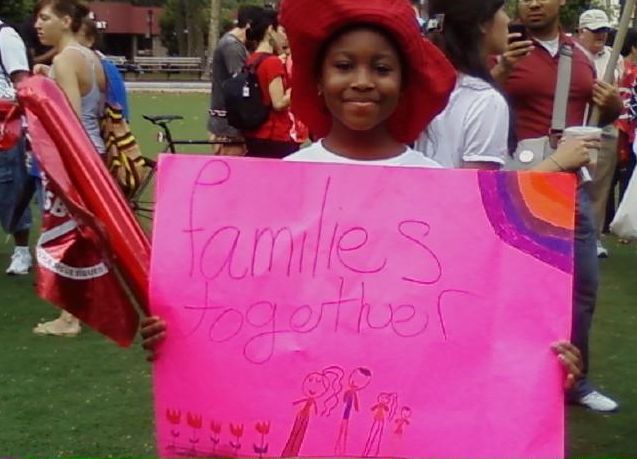
As someone who's taught Constitutional history on the college level, we're not surprised that a federal judge issued a temporary injunction of the enforcement of SB 1070 on preemption grounds. But the law is now in effect, and those of us who hate this racist, xenophobic, un-American creation of the hateful extremists who control Arizona government - including our campaign, which is still boycotting Arizona - participated all over the state and country in a National Day of Action against SB 1070. We were in our native Brooklyn early to gather for a march over the Brooklyn Bridge and rally at Foley Square in lower Manhattan. Here are pics we took at the rally.


Our event today in New York was organized by the New Sanctuary Movement, Families for Freedom, Immigrant Defense Project,

Churches United to Save & Heal, Northern Manhattan Coalition for Immigrant & Refugee Rights,

DRUM-Desis Rising Up & Moving, Black Institute, VAMOS Unidos,

American Friends Service Committee, and Wind of the Spirit (New Jersey).

It was sponsored by, among others, the Northwest Bronx Community and Clergy Coalition,

Damayan, Sistas and Brothas United, NY Immigration Coalition, World Can’t Wait, Sikh Coalition,

Urban Youth Collaborative, Immigrant Communities in Action, Center for Immigrant Families,

United for Peace and Justice, South Asian Americans Leading Together,

Boycott Arizona Coalition, Muslim Consultative Network, New Immigrant Community Empowerment,

CAAAV, Center for Constitutional Rights, Peekskill Area Pastors Association, La Union,

National Economic & Social Rights Initiative, Coney Island Avenue Project, Youth on the Move,

South Asian Bar Association of NY, Asian American Legal Defense & Education Fund, Adhikaar, NYS Youth Leadership Council

- and that list isn't comprehensive, as you can tell by glancing at some of the banners here.


If elected to Congress, we will support comprehensive immigration reform with a path to citizenship.