Showing posts with label the Great Recession. Show all posts

Wednesday, October 13, 2010

Jeff Flake, Arizona Is in an Economic Depression and You Do Nothing But Extol Free Markets and Ask for Tax Cuts for Millionaires


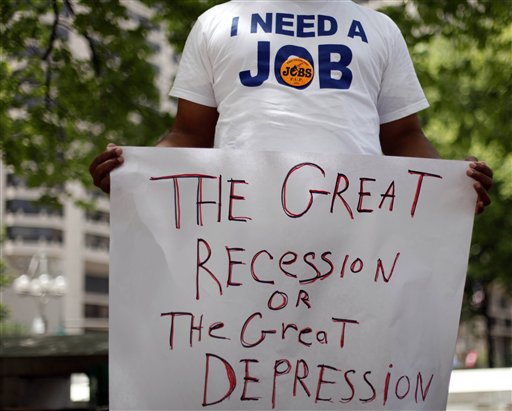
Tomorrow's New York Times features a very long front-page story by our friends Michael Powell and Motoko Rich, "Across the U.S., Long Recovery Looks Like Recession." For those of us in the East Valley and in Pinal County, where our house is, the Great Recession's sputtering recovery seems more like the Great Depression:

Florence, Ariz.

In 2005, Arizona ranked, as usual, second nationally in job growth behind Nevada, its economy predicated on growth. The snowbirds came and construction boomed and land stretched endless and cheap. Then it stopped.

This year, Arizona ranks 42nd in job growth. It has lost 287,000 jobs since the recession began, and the fall has been calamitous.

Renee Wheaton, 38, sits in an old golf cart on the corner of Tangerine and Barley Roads in her subdivision in the desert, an hour south of Phoenix. Her next-door neighbor, an engineer, just lost his job. The man across the street is unemployed.

Her family is not doing so well either. Her husband’s hours have been cut by 15 percent, leaving her family of five behind on water and credit card bills — more or less on everything except the house and car payment. She teaches art, but that’s not much in demand.

“I say to myself ‘This can’t be happening to us: We saved, we worked hard and we’re under tremendous stress,’ ” Ms. Wheaton says. “My husband is a very hard-working man but for the first time, he’s having real trouble.”

Arizona’s poverty rate has jumped to 19.6 percent, the second-highest in the nation after Mississippi. The Association of Arizona Food Banks says demand has nearly doubled in the last 18 months.

Elliott D. Pollack, one of Arizona’s foremost economic forecasters, said: “You had an implosion of every sector needed to survive. That’s not going to get better fast.”

To wander exurban Pinal County, which is where Florence is located, is to find that the unemployment rate tells just half the story. Everywhere, subdivisions sit in the desert, some half-built and some dreamy wisps, like the emerald green putting green sitting amid acres of scrub and cacti. Signs offer discounts, distress sales and rent with the first and second month free.

Discounts do not help if your income is cut in half. Construction workers speak of stringing together 20-hour weeks with odd jobs, and a 45-year-old woman who was a real estate agent talks of her job making minimum wage bathing elderly patients. Many live close to the poverty line, without the conveniences they once took for granted. Pinal’s unemployment rate, like that of Arizona, stands at 9.7 percent, but state officials say that the real rate rises closer to 20 percent when part-timers and those who have stopped looking for work are added in.

At an elementary school near Ms. Wheaton’s home, an expansion of the school’s water supply was under way until thieves sneaked in at night and tore the copper pipes out of the ground to sell for scrap.

Five miles southwest, in Coolidge, a desert town within view of the distant Superstition Mountains, demand has tripled at Tom Hunt’s food pantry. Some days he runs out.

Henry Alejandrez, 60, is a roofer who migrated from Texas looking for work. “It’s gotten real bad,” he says. “I’m a citizen, and you’re lucky if you get minimum wage.”

Mary Sepeda, his sister, nods. She used to drive two hours to clean newly constructed homes before they were sold. That job evaporated with the housing market. (Arizona issued 62,500 housing permits several years ago; it gave out 8,400 last year.)

“It’s getting crazy,” she says, holding up a white plastic bag of pantry food. “How does this end?”

You put that question to Mr. Pollack, the forecaster. “We won’t recover until we absorb 80,000 empty houses and office buildings and people can borrow again,” he says.

When will that be?

“I’m forecasting recovery by 2013 to 2015,” he says.

Hmm, Jeff Flake will be his seventh or eighth term in Congress by then. Till that time, he'll continue his crusade against any government spending to stimulate the economy, he'll continue voting against unemployment insurance and any "safety net" for the middle class-turned-poor, and he'll continue his fight to make sure that comfortable millionaires and billionaires pay no taxes.

And of course he'll take credit for the eventual economic recovery although he did everything he could -- deregulate and let the money men run wild on Wall Street -- to create the Great Recession.

And of course you, the asshole voters of the Sixth Congressional District, will just keep voting for him and the other right-wing Republicans.

Friday, September 3, 2010

How to Fix Our Jobs Crisis and Why Jeff Flake, Hopelessly Drunk on Dime-Store Milton Friedman and Ayn Rand, Will Do Nothing to Help You


Rep. Jeff Flake is a hopeless drunk.

No, not on alcohol. Like us, we assume he's a teetotaler. What he's been drunk on all his adult life is dime-store Milton Friedman and Ayn Rand. Now like us, Friedman and Rand were Jews who didn't believe in God, so we admire their intelligence. But they need to be taken along with a heavy dose of critical thinking and skepticism. They got a lot of things wrong.

That said, since we're teetering on the verge of 1990s Japanese-style deflation, we hope Jeff Flake remembers Milton Friedman's cure for that: a helicopter drop of money over our citizens. That means the government has to spend some money.

But Jeff Flake forgets that part of Friedman because, well, he's just a fanatic far to the right of Friedman. He believes government can do nothing, nothing, nothing. That's why he wants to be elected to his fifth term in Congress (after getting elected promising to term-limit himself): he's not through doing nothing.

Oh, we forgot about Flake's cutting taxes for very, very rich people.

Former Labor Secretary Robert Reich, in an op-ed in today's New York Times, "How to End the Great Recession," explains how we got here and some possible ways out (emphasis ours):
This promises to be the worst Labor Day in the memory of most Americans. Organized labor is down to about 7 percent of the private work force. Members of non-organized labor — most of the rest of us — are unemployed, underemployed or underwater. Friday’s jobs report from the Bureau of Labor Statistics will almost surely show fewer new jobs created in August than the 125,000 needed just to keep up with growth of the potential work force.

The national economy isn’t escaping the gravitational pull of the Great Recession. None of the standard booster rockets are working: near-zero short-term interest rates from the Fed, almost record-low borrowing costs in the bond market, a giant stimulus package and tax credits for small businesses that hire the long-term unemployed have all failed to do enough.

That’s because the real problem has to do with the structure of the economy, not the business cycle. No booster rocket can work unless consumers are able, at some point, to keep the economy moving on their own. But consumers no longer have the purchasing power to buy the goods and services they produce as workers; for some time now, their means haven’t kept up with what the growing economy could and should have been able to provide them.

This crisis began decades ago when a new wave of technology — things like satellite communications, container ships, computers and eventually the Internet — made it cheaper for American employers to use low-wage labor abroad or labor-replacing software here at home than to continue paying the typical worker a middle-class wage. Even though the American economy kept growing, hourly wages flattened. The median male worker earns less today, adjusted for inflation, than he did 30 years ago.

But for years American families kept spending as if their incomes were keeping pace with overall economic growth. And their spending fueled continued growth. How did families manage this trick? First, women streamed into the paid work force. By the late 1990s, more than 60 percent of mothers with young children worked outside the home (in 1966, only 24 percent did).

Second, everyone put in more hours. What families didn’t receive in wage increases they made up for in work increases. By the mid-2000s, the typical male worker was putting in roughly 100 hours more each year than two decades before, and the typical female worker about 200 hours more.

When American families couldn’t squeeze any more income out of these two coping mechanisms, they embarked on a third: going ever deeper into debt. This seemed painless — as long as home prices were soaring. From 2002 to 2007, American households extracted $2.3 trillion from their homes.

Eventually, of course, the debt bubble burst — and with it, the last coping mechanism. Now we’re left to deal with the underlying problem that we’ve avoided for decades. Even if nearly everyone was employed, the vast middle class still wouldn’t have enough money to buy what the economy is capable of producing.

Where have all the economic gains gone? Mostly to the top. The economists Emmanuel Saez and Thomas Piketty examined tax returns from 1913 to 2008. They discovered an interesting pattern. In the late 1970s, the richest 1 percent of American families took in about 9 percent of the nation’s total income; by 2007, the top 1 percent took in 23.5 percent of total income.

It’s no coincidence that the last time income was this concentrated was in 1928. I do not mean to suggest that such astonishing consolidations of income at the top directly cause sharp economic declines. The connection is more subtle.

The rich spend a much smaller proportion of their incomes than the rest of us. So when they get a disproportionate share of total income, the economy is robbed of the demand it needs to keep growing and creating jobs.

What’s more, the rich don’t necessarily invest their earnings and savings in the American economy; they send them anywhere around the globe where they’ll summon the highest returns — sometimes that’s here, but often it’s the Cayman Islands, China or elsewhere. The rich also put their money into assets most likely to attract other big investors (commodities, stocks, dot-coms or real estate), which can become wildly inflated as a result.

Meanwhile, as the economy grows, the vast majority in the middle naturally want to live better. Their consequent spending fuels continued growth and creates enough jobs for almost everyone, at least for a time. But because this situation can’t be sustained, at some point — 1929 and 2008 offer ready examples — the bill comes due.

This time around, policymakers had knowledge their counterparts didn’t have in 1929; they knew they could avoid immediate financial calamity by flooding the economy with money. But, paradoxically, averting another Great Depression-like calamity removed political pressure for more fundamental reform. We’re left instead with a long and seemingly endless Great Jobs Recession.

THE Great Depression and its aftermath demonstrate that there is only one way back to full recovery: through more widely shared prosperity. In the 1930s, the American economy was completely restructured. New Deal measures — Social Security, a 40-hour work week with time-and-a-half overtime, unemployment insurance, the right to form unions and bargain collectively, the minimum wage — leveled the playing field.

In the decades after World War II, legislation like the G.I. Bill, a vast expansion of public higher education and civil rights and voting rights laws further reduced economic inequality. Much of this was paid for with a 70 percent to 90 percent marginal income tax on the highest incomes. And as America’s middle class shared more of the economy’s gains, it was able to buy more of the goods and services the economy could provide. The result: rapid growth and more jobs.


By contrast, little has been done since 2008 to widen the circle of prosperity. Health-care reform is an important step forward but it’s not nearly enough.

What else could be done to raise wages and thereby spur the economy? We might consider, for example, extending the earned income tax credit all the way up through the middle class, and paying for it with a tax on carbon. Or exempting the first $20,000 of income from payroll taxes and paying for it with a payroll tax on incomes over $250,000.

In the longer term, Americans must be better prepared to succeed in the global, high-tech economy. Early childhood education should be more widely available, paid for by a small 0.5 percent fee on all financial transactions. Public universities should be free; in return, graduates would then be required to pay back 10 percent of their first 10 years of full-time income.

Another step: workers who lose their jobs and have to settle for positions that pay less could qualify for “earnings insurance” that would pay half the salary difference for two years; such a program would probably prove less expensive than extended unemployment benefits.
These measures would not enlarge the budget deficit because they would be paid for. In fact, such moves would help reduce the long-term deficits by getting more Americans back to work and the economy growing again.

Policies that generate more widely shared prosperity lead to stronger and more sustainable economic growth — and that’s good for everyone. The rich are better off with a smaller percentage of a fast-growing economy than a larger share of an economy that’s barely moving. That’s the Labor Day lesson we learned decades ago; until we remember it again, we’ll be stuck in the Great Recession.

Jeff Flake has already said he won't do a thing to help you if your family is struggling economically.

But you live in the East Valley and are an asshole. That's why you and most of your moronic neighbors will vote to re-elect him. You and your congressman deserve each other.

Monday, August 30, 2010

Why Reviving Revenue Sharing Would Be Good for America -- and Arizona


The number one issue of this campaign, and of the last couple of years of the Great Recession, is how to get our economy moving again. Right now, policy makers seem paralyzed by outdated notions, fear, and political dissent by those like Jeff Flake, who are wrong, wrong, wrong about everything.

Jeff Flake and the Republicans' solution to our economic crisis and terrible unemployment is their usual laissez-faire, trickle-down, supply-side, yada yada crap that started us on the path to extremes of wealth and poverty but mostly great gains for the very, very richest of Americans and bupkis or losses for the other ninety percent and more of us.

Their solution to everything is to cut government spending (which they certainly failed at spectacularly during their years of federal control in the Bush adminstration) and lower taxes: Grover Norquist's "Starve the Beast." Because Jeff Flake - although he's got his sinecure right in the middle of it - hates the federal government and thinks it can do nothing.

So when the Republicans take control of Congress, and if they gain the White House in two years, will drastically cut out needed spending just as they opposed the stimulus. Yesterday we reprinted a column by Laura Tyson explaining why the first stimulus did work but was too small to be effective in such a virulent Great Recession caused by a major financial catastrophe and why we need a second stimulus.

Today we post a column, from the Business section of yesterday's New York Times, by economist Robert J. Shiller on one form the stimulus can take, "The Case for Reviving Revenue Sharing." Revenue sharing is something that even conservative Republicans should like because it takes decision to the state and local level, but real fanatic extremists like Jeff Flake can never be satisfied in their irrational hatred of government at all levels. (We wonder if Jeff Flake's toilet training caused his psychological problems.) Herewith, Shiller's proposal:

PROTRACTED unemployment is eating away at millions of people. And the economy’s failure to create enough jobs for them is part of a vicious circle that could keep turning for years to come.

In my last column, I called for big, temporary government programs aimed directly at putting people back to work. But how might we best accomplish this? The clock is ticking, and we don’t have time to create new national organizations to employ people. Instead, the most efficient approach is to use existing organizations for specific ideas and projects.

State and local governments as well as nonprofit and other organizations need to be mainstays in this effort. We need to enlist their help — without telling them exactly what to do. As for a framework, think of the general revenue sharing program adopted by Congress in 1972.

In his 1971 State of the Union message, President Richard M. Nixon advocated general revenue sharing to offset the tendency for power to be concentrated in Washington. Give local governments the money and “put the power to spend it where the people are,” he said.

Support for the idea was not confined to Republicans. A leading Democrat, Senator Hubert H. Humphrey, supported it in 1972, saying that federal taxes were more progressive than state and local ones and that federal money could be spent more effectively by people with local knowledge than by “some agency head in Washington.”

General revenue sharing came under attack in the Reagan years, and Congress ended it in 1987, arguing that by breaking the link between taxation and local needs, it encouraged higher taxes.

We are in a different time now. State and local governments are in severe fiscal trouble, and their constitutions often prevent deficit spending. In these circumstances, the federal government, which does not face such constraints, needs to raise revenue for them.

Legislation providing the states with $26 billion, which President Obama signed into law this month, took an important step in this direction. It did not create true general revenue sharing, because it tied the funds to specific needs — mostly hiring teachers and paying for Medicaid. But it did free states to use other resources as they saw fit.
(Illustration by David G. Klein)

It is time to bring back true general revenue sharing — temporarily — to stimulate the economy. Hundreds of articles in political science and public policy journals have studied past efforts, and analyzed the concept of fiscal federalism, without establishing general revenue sharing as a fundamental pillar of Keynesian stabilization policies. This lapse is understandable: most of these articles were written before the current economic crisis, the most serious since the Great Depression.

The need for a Keynesian revenue-sharing program is clear. After Congress approved stimulus legislation in 2009, Lawrence H. Summers, head of the National Economic Council, said that “it’s harder to spend $300 billion within a year on quality projects than you might think.” And no wonder the task was tough: decision makers in Washington were removed from local needs.

Martin Shubik, a professor of mathematical institutional economics at Yale, has proposed creating a “Federal Employment Reserve Authority,” a permanent agency that would do extensive research and maintain a detailed list of ready-to-go public works projects should a recession come. That’s a great idea, but we do not have such an agency now, and, if we did, it might still suffer from a Washington bias.

Now, local governments are laying off a wide variety of employees, including teachers, police officers and social workers. So why don’t we embrace general revenue sharing? Unfortunately, when faced with a need for stimulus, members of Congress seem to prefer to start their own projects, for which they are likely to get more credit from voters. Local governments, meanwhile, which are more likely to know where spending is really needed, remain in deep trouble.

It’s time for the public to assert loftier expectations. We need to respect existing government bureaus and organizations for their ideas, and get down to the business of financing important jobs temporarily, and on a huge scale. This will avert more layoffs, and perhaps give cities and states time to recover to the point they can pay local employees from local revenue.

When the administration of Franklin D. Roosevelt began its vast job creation program in 1933, it had to accept certain practical realities, which limited the immediate stimulus that could be provided. Foremost among them was that the government had to work largely within the framework of existing organizations — whether state and local governments, the military or nonprofit groups — which provided much of the economy’s infrastructure.

Economic stimulus is not a matter of turning on the money spigot, as some economists are wont to describe it. It is about getting the widespread cooperation of dispersed organizations to provide jobs, at least for as long as the economy is weak.

When the Roosevelt administration and Congress created the Civilian Conservation Corps in 1933, it was done within the framework of the Army. There seemed to be no other organization that could move hundreds of thousands of young men into wilderness encampments where they could work on conservation efforts. But the Roosevelt C.C.C. placed no more than a half-million people in jobs. We need to reach further than that.

Labor unions, which represent workers who naturally fear displacement by people in new jobs, might seem to be an obstacle. But unions do have an idealistic base, and working union members have sons and daughters and friends and relatives who are unemployed. The unions need to be consulted if new jobs are to be created in a relatively nonthreatening way. In a savvy move, President Roosevelt made a union leader the head of the C.C.C.

The concept of general revenue sharing can also be extended to the nation’s nonprofits, including charities and foundations. The government has long given support to such organizations, but usually in the form of narrow grants. But broader general revenue grants could be made in times like these.

Millions of people need jobs, and there are organizations that could help put them to work. It’s time to move forward.